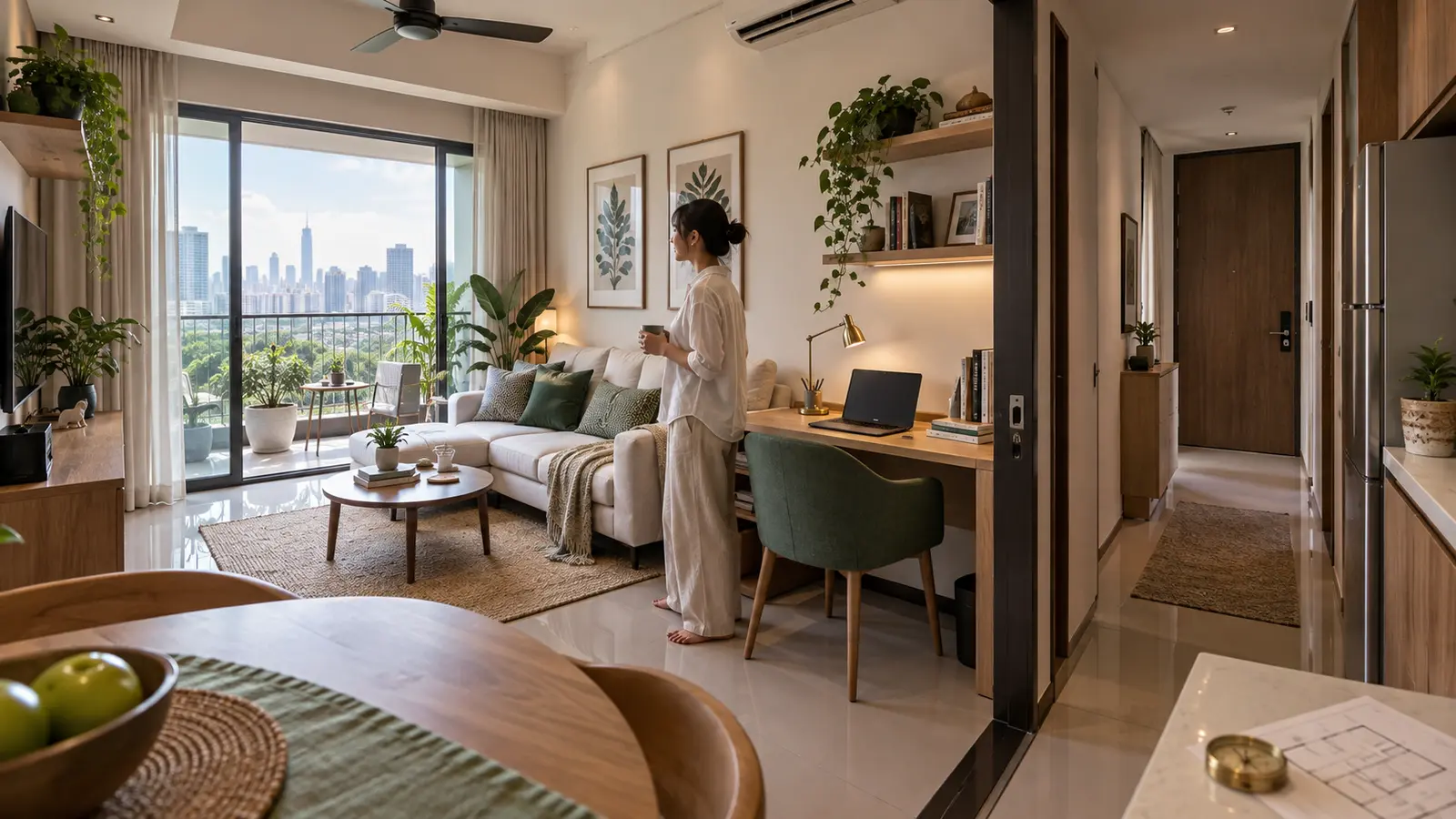
Many Malaysian homes are not detached houses with a clear front garden and several rooms. They are high-rise units reached through a guardhouse, lift lobby and shared corridor; one room may need to support work, rest and family life. That does not make Feng Shui irrelevant. It changes the scale of the questions. A responsible reading considers the wider development, the tower and shared route, then the private unit and the way its limited space is actually used.
The short answer: the principles are not limited by square footage.
Feng Shui is a traditional Chinese interpretive framework concerned primarily with relationships among people, surroundings, form, layout, orientation and, in some schools, time. Those relationships still exist in a small apartment. What changes is how much control the resident has, how several functions overlap and which observations belong to the shared building rather than the unit itself.
A compact home is not automatically poor Feng Shui, and a large home is not automatically good Feng Shui. Size changes the constraints; it does not produce a verdict.
Read a condo at three connected scales
| Scale | What it includes | What the resident can usually change |
|---|---|---|
| Development and surroundings | Roads, neighbouring towers, slope, open space, drop-off, pedestrian access and the relationship between buildings. | Usually very little. The useful task is to observe the real conditions and decide whether they suit the household. |
| Tower, floor and shared route | Common entrance, lobby, lift or stairs, corridor, physical height, exposure, noise and emergency access. | Residents may raise maintenance issues, choose routes or improve personal routines, but strata rules and common property limits apply. |
| Private unit | Unit entrance, room arrangement, windows, balcony, circulation, privacy, light, heat, airflow and daily use. | Furniture, storage, lighting, screens, curtains and routines may be adjusted within safety, tenancy and management rules. |
Keep these scales separate before connecting them. A pleasant unit does not erase a serious access problem outside it, while an imperfect shared corridor does not tell you everything about the home inside.
What is different about Feng Shui in a high-rise home?
The approach is shared
Arrival may begin at the compound gate or lobby rather than at the unit door. The lift, corridor and common entrance are part of the lived route, but they are not privately owned rooms.
The apparent front may be unclear
A balcony, largest windows and unit door can point in different directions. Do not guess a formal facing direction from a floor plan, view or unit number; a named school should explain how it determines orientation.
Homes are stacked
Units above, below and beside each other share structure, services and sound. Observable issues such as leaks, vibration, smells or noise need management, maintenance or qualified advice before symbolic explanation.
Rooms carry several jobs
A dining table may also be a desk and homework station. Instead of forcing one permanent label, consider how light, activity, privacy and storage change through the day.
Control is limited
External walls, windows, doors, plumbing, balconies and corridors may be governed by strata, tenancy and fire-safety rules. A useful response must respect those boundaries.
A practical small-apartment walkthrough
Begin with observable experience before applying a traditional model. Walk through the home at the times it is normally used:
Arrival and entrance
Can the door open fully? Are shoes, parcels or furniture narrowing the route? Check lighting, locks, trip hazards and emergency clearance first.
Main circulation
Follow the path from entrance to living area, kitchen, bathroom and bedrooms. In a small home, one misplaced item can interrupt several routes at once.
Windows and balcony
Notice daylight, afternoon heat, glare, rain exposure, privacy, child safety and airflow. A beautiful view does not replace secure railings, waterproofing or suitable shading.
Living and work zones
Ask which activities compete. A movable screen, task light, cable control or agreed work period may create a clearer boundary without pretending the room has become larger.
Sleep areas
Look at noise, temperature, light, door clearance and whether work equipment remains visually active at bedtime. Rest needs may differ among household members.
Kitchen, bathroom and service areas
Ventilation, moisture, cleanliness, drainage, gas and electrical safety are practical conditions. Persistent dampness, mould, leaks or faults need qualified attention.
Small space makes proportion more important—not more frightening.
In a compact unit, every change occupies a larger share of the available room. A large ornament, mirror, plant or water feature can obstruct movement, increase glare, demand maintenance or create risk. The question is not whether a popular object is ‘good Feng Shui’ in general. Ask whether its size, position and ordinary function support this home and its users.
- Keep exits, doors and walking paths clear.
- Use furniture that matches the room rather than an idealised online layout.
- Create flexible zones when one space has several purposes.
- Choose light, shade and ventilation for actual heat and use patterns.
- Avoid buying symbolic objects that create clutter, fear or maintenance problems.
What can a renter change without renovating?
Renters and strata owners can often make modest, reversible improvements. These are not guaranteed Feng Shui cures; they are practical adjustments that may help a space support its purpose while leaving room for a clearly named traditional interpretation.
- Clear and store: Remove obstructions from the entrance and essential routes; use closed or vertical storage where it does not create a tipping risk.
- Zone activities: Use a rug, movable screen, lamp or routine to distinguish work, social and rest periods without blocking ventilation or exits.
- Manage light and privacy: Curtains, blinds and task lighting can respond to glare and visibility. Check fixtures, drilling permission and fire safety.
- Reduce avoidable disturbance: Furniture pads, door stops, agreed quiet periods or changing a desk position may help with everyday noise and movement.
- Document building issues: Report leaks, electrical faults, pests, lift problems, blocked exits and common-property defects through the proper management or professional channel.
Do you need a compass reading for every apartment?
Not every beginner observation requires a formal direction. You can first assess access, movement, heat, light, noise, privacy and use. When a Feng Shui school relies on orientation or time, accurate on-site information may matter, especially where a unit door, balcony and tower face differently. A screenshot, marketing plan or phone compass used beside metal and electrical equipment may not settle the question.
For the wider framework, start with What Is Feng Shui? If a reading uses the Bagua, Lo Shu or Flying Stars, keep each model’s own role and rules instead of combining them into a home-made chart.
What about the block, floor and unit number?
Those labels describe an apartment address, but they are not the complete Feng Shui of the property. The physical floor, route and building context may matter spatially; the printed digits do not cause the observed light, heat, access or noise. Cultural preferences and a defined number-analysis system are separate interpretive layers.
The dedicated guide Do Apartment Floor, Block and Unit Numbers All Matter? explains which identifier to start with and why the labels should not be joined automatically. Monad Mind’s Eight Star framework considers complete active number sources and adjacent relationships; it does not calculate a condo’s Feng Shui from its unit number.
Example: a 650-square-foot Kuala Lumpur condo
Imagine two adults sharing a one-bedroom unit. The entrance opens near the kitchen, the dining table is also a work desk, afternoon sun heats the balcony wall and bags narrow the bedroom route. A useful first response is to clear the path, review shading and cooling, give work equipment a closing routine and check whether furniture scale fits the room. If the household then wants a Feng Shui assessment, the practitioner can examine the development, shared approach, unit layout, orientation and chosen school. Buying a ‘lucky’ object or judging the unit digits first would leave the main conditions unanswered.
What should come before symbolic interpretation?
Affordability, title or tenancy terms, building condition, fire exits, security, lift reliability, accessibility, ventilation, daylight, heat, water, noise, commute and household needs take priority. Structural, electrical, gas, waterproofing, mould, fire-safety, legal or financial concerns require the relevant qualified professional. A traditional reading may add perspective; it cannot certify the unit or overrule evidence.
Common small-home mistakes
Copying a landed-house rule exactly
A rule developed for a different entrance, scale or surrounding form may not transfer directly to a stacked unit.
Calling clutter ‘bad energy’ and stopping there
Storage pressure is real, but the answer may involve furniture, routines or household agreement rather than a frightening label.
Forcing a permanent room identity
One room can serve different purposes at different times. Study transitions and users, not only the label on a plan.
Treating the unit number as the whole home
An address digit does not contain the layout, orientation, surroundings, condition or users.
Making unsafe or unauthorised changes
Never block exits, overload sockets, hang heavy objects insecurely or alter common property without approval.
What Feng Shui cannot promise in a condo
Feng Shui is not established physical science. It cannot prove that a room caused an event, diagnose or treat illness, certify structural or fire safety, prevent crime or accidents, guarantee protection, wealth, recovery, relationships, pregnancy, career or property value, or predict an exact event or date. It does not replace medical, mental-health, legal, financial, engineering, building, property or fire-safety advice.
Frequently asked questions
Can Feng Shui be used in a condominium?
Yes, as a traditional interpretive perspective. Consider the wider development, shared approach and private unit, while recognising which parts the resident cannot control.
Is a small apartment automatically bad Feng Shui?
No. Size creates practical limits but does not determine a verdict. Layout, use, surroundings, comfort and the chosen method all need context.
Which entrance matters in a condo?
The development, tower and unit entrances can describe different scales of the lived approach. Their relevance depends on the question and named Feng Shui school.
Can renters improve Feng Shui without renovation?
They can make safe, reversible changes to storage, lighting, privacy, activity zones and routines. Follow tenancy, strata and fire-safety rules.
Does the unit number decide the Feng Shui?
No. A unit number is an address identifier and may be considered separately through culture or a number-analysis method. It does not describe the complete environment.
Should I use the balcony or unit door as the facing direction?
Do not assume one universal answer. Schools can determine facing differently, and a formal orientation-based reading should explain its method and use accurate site information.
Begin with the real unit, not an ideal floor plan.
A small Malaysian apartment still contains relationships among people, surroundings, movement, orientation and time. Observe them at development, shared-building and private-unit levels. Make safe, proportionate changes where you have control, and keep Feng Shui, cultural symbolism, number analysis and ordinary housing decisions clearly separated.