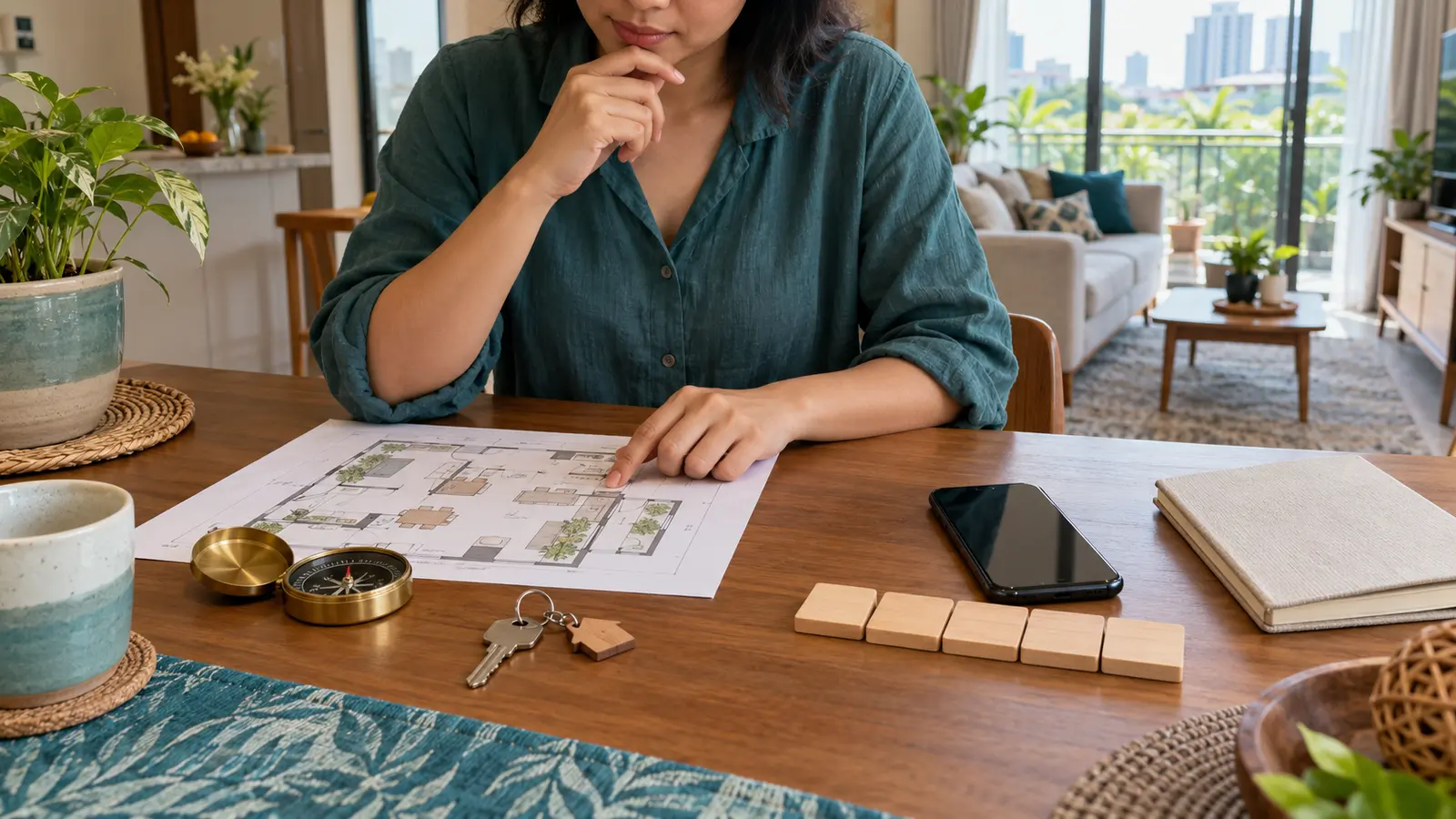
Feng Shui and numerology are often placed together because both can involve traditional symbolism, patterns and numbers. The overlap is real, but limited. Feng Shui begins with a place: its surroundings, form, entrance, layout, orientation and, in some schools, time. Numerology begins with a number source and the rules used to interpret it. Confusing the two can turn a useful comparison into an invented formula.
The short answer: related conversations, different starting points.
Feng Shui is a traditional Chinese interpretive framework concerned mainly with how people relate to a physical environment. Numerology is an umbrella term for systems that assign symbolic meaning to numbers, dates, names or sequences. A Feng Shui method may use numbered categories, but that does not make the whole practice numerology.
If Feng Shui is new to you, begin with the simple guide to Feng Shui for modern homes. It explains the environmental foundation before numbers enter the discussion.
Feng Shui and numerology side by side
The clearest distinction is not whether a number appears. It is what the method treats as its main subject and what question it is trying to answer.
| Question | Feng Shui | Numerology |
|---|---|---|
| What does it begin with? | A site, building, room or surrounding environment. | A selected number source, date, name or sequence. |
| What does it mainly examine? | Form, approach, entrance, layout, movement, orientation and sometimes time. | Symbolic meanings or patterns produced by a defined number system. |
| Why may numbers appear? | They can label trigrams, positions, directions, relationships or time-related configurations. | Numbers are the central material being interpreted. |
| Does physical space matter? | Yes. The real environment is central to the reading. | Only when the chosen system or question includes a place or address. |
| Can it judge a home from one digit? | No. One digit cannot describe the property’s complete Feng Shui. | A responsible reading follows its full method and should not generalise from one preferred digit. |
Why are there numbers in Feng Shui if it is not numerology?
A number can do different jobs in different systems. In Feng Shui, numbers may organise a traditional model rather than describe the personal meaning of a phone, birth date or address. For example, the Bagua has eight trigrams; the Lo Shu places numbers in a traditional square; and Flying Star schools use numbered stars with spatial and time-related roles. Those numbers belong to their own frameworks.
- A numbered Feng Shui category is not automatically a lucky or unlucky digit.
- The number attached to a direction or time pattern does not become a universal personal meaning.
- Using the word “eight” does not make the Bagua and Eight Star Number Energy the same method.
- Lo Shu and Flying Star numbers should not be copied into an unrelated numerology calculation.
Cultural number symbolism is a third, separate layer.
In Malaysian and wider Chinese communities, preferences around digits such as 8 or 4 often reflect language, sound associations, custom and market behaviour. These beliefs can affect how a house, phone number or vehicle registration feels to a person—and sometimes how other people respond to it. That social effect is real enough to consider, but it is not the same as the complete Feng Shui of a property or a complete numerology reading.
The guide Are 8 and 4 Always Lucky or Unlucky? explores that distinction without turning cultural preference into a universal rule.
One home, four different questions
Imagine someone is considering a condominium unit. The same property can be viewed through several lenses, but each lens needs its own inputs:
- Feng Shui question: How do the building approach, unit entrance, layout, orientation, surrounding forms and actual use of the rooms relate to the occupants?
- Cultural-symbolism question: Does the unit number carry a familiar sound association or personal meaning that may affect preference or resale conversations?
- General numerology question: How does a named numerology system prepare and interpret the address or unit number?
- Monad Mind Eight Star question: What patterns appear within the complete active property-number source, including recognised adjacent relationships, order, purpose and exposure?
These questions may sit beside one another, but one answer cannot substitute for the others. A preferred number does not repair poor ventilation or an unsafe entrance; a comfortable layout does not tell you how a numerology system would interpret the unit number.
Where does Monad Mind’s Eight Star Number Energy fit?
Monad Mind’s Eight Star framework belongs on the number-analysis side of the comparison. It considers a complete active source—such as a phone number, IC number, prepared name, vehicle registration, property number or business source—and examines recognised adjacent relationships in order, together with the source’s purpose, context and exposure. It does not calculate the Feng Shui of a building.
For the wider numerology context, read What Is Numerology—and How Is Eight Star Numerology Different?. For the language used around patterns, read What Does “Number Energy” Mean?.
Can Feng Shui and numerology be used together?
They can be considered as separate interpretive perspectives, provided the method and limits of each remain visible. Someone might first assess whether a home is affordable, safe and practical, then consider its layout and orientation through a Feng Shui school, and separately explore the unit number through a named numerology method. The conclusions can be compared at the level of reflection—not merged into a new calculation.
Name the framework
Say whether a statement comes from Feng Shui, cultural symbolism, numerology or Eight Star.
Keep inputs separate
Do not insert a house-number total into a Feng Shui chart unless that specific school actually requires it.
Avoid double counting
A repeated theme from two interpretive systems is still not proof of physical causation.
Return to the real decision
Safety, building rules, legal terms, affordability, comfort and qualified advice take priority.
So, is a house number Feng Shui or numerology?
The number on a door is an identifier. Interpreting its digits usually belongs to cultural number symbolism or a numerology system. Some practitioners may include it as an optional symbolic layer, but it cannot stand in for the land, building, entrance, layout, orientation or time factors considered in Feng Shui.
If your question is specifically about the number source, continue to What Can Your House Number Tell You? That guide owns the complete property-number intent rather than repeating it here.
Which framework should you start with?
- Start with Feng Shui when the question is about the surroundings, entrance, room arrangement, movement, orientation or use of a space.
- Start with cultural context when the main concern is how a community, family or market may respond to a particular digit.
- Start with numerology when the question is about the symbolic interpretation of a defined number, date, name or sequence.
- Start with ordinary professional advice when the concern involves structure, fire safety, security, health, law, financing, valuation or mental wellbeing.
Different frameworks share the same responsibility: no guaranteed outcomes.
Neither Feng Shui nor numerology should be presented as established physical science. Neither can prove that one feature or number caused an event, certify a building as safe, diagnose illness or guarantee protection, wealth, recovery, relationships, career success, business results or a precise date. Use conditional language, observe what can actually be checked and seek qualified advice for high-stakes decisions.
Frequently asked questions
Is Feng Shui a type of numerology?
No. Feng Shui is primarily an environmental and spatial framework. Some schools use numbers, but those numbers operate within Feng Shui’s own models.
Why do Feng Shui practitioners talk about numbers?
Numbers may label trigrams, positions, directions, symbolic relationships or time-related configurations. Their role depends on the school and is not automatically the same as a numerology meaning.
Is a house number part of Feng Shui?
It may be considered as an optional symbolic layer, but it is not the complete Feng Shui of a property. Interpreting the digits themselves usually belongs to cultural symbolism or a number-analysis system.
Are 8 and 4 Feng Shui numbers?
They are widely discussed through Chinese-language sound associations and cultural preference. That does not make either digit universally beneficial or difficult in every Feng Shui or numerology system.
Can I combine a Feng Shui chart with an Eight Star reading?
You may compare them as separate perspectives, but you should not merge their inputs or rules into an invented formula. Eight Star analyses complete active number sources; it does not calculate a building’s Feng Shui.
Which matters more when choosing a home: Feng Shui or its number?
Begin with affordability, legal and building checks, safety, location and practical fit. A Feng Shui assessment and a separate number reading may then add optional perspectives.
Separate the question before comparing the answer.
Ask whether you are examining a place, a cultural association or a number source. Once that is clear, Feng Shui and numerology can be understood without pretending that every numbered tradition is one system.