No. In many Chinese-speaking communities, 8 is popularly associated with prosperity while 4 may be avoided because of how the words can sound in some Chinese languages. Those associations can influence preferences, prices and design choices. They do not prove that one digit causes an outcome, and they are not the same as an Eight Star Number Energy reading.
The short answer: cultural meaning is real, but it is not a guaranteed result.
A number can carry a shared cultural story and still have no power to promise what will happen. Someone may choose 8 because it feels positive, avoid 4 because it feels uncomfortable, or feel neutral about both. These are understandable preferences. They should be separated from claims that a single digit can secure wealth, safety, health, relationships or success.
Why is 8 often treated as lucky?
In many Chinese-language settings, the spoken sound associated with 8 is popularly linked with words or ideas connected to prosperity. Over time, that wordplay has become a familiar symbol in phone numbers, addresses, vehicle registrations, opening dates and prices. The association is social and cultural: people may value the digit because other people also recognise the story.
That preference is not identical across every Chinese language, country, generation, family or person. Even where it is widely recognised, 8 cannot establish that a purchase, launch or decision will succeed.
Why is 4 sometimes avoided?
In some Chinese languages, the spoken word for 4 can resemble the word for death. This sound association can make the digit feel uncomfortable in addresses, floor labels, phone numbers or gifts. Some buildings and businesses adapt their numbering because occupants or buyers care about that perception.
Avoidance is not universal, and the presence of 4 does not predict harm, illness, loss or death. Treating the digit as a warning about an unavoidable event goes far beyond the cultural association and is not responsible.
Three layers that are easy to mix up
| Layer | What it describes | What it cannot establish |
|---|---|---|
| Cultural association | A meaning shared through language, custom, family or community. | That the digit physically causes luck or misfortune. |
| Personal preference | How comfortable, memorable or appropriate a number feels to one person. | That everyone must value or avoid the same digit. |
| Eight Star interpretation | A traditional reading of recognised adjacent pairs within a complete source and its context. | A guaranteed event, scientific cause or universal lucky-number list. |
How does Eight Star read 8 and 4?
Eight Star Number Energy is a traditional interpretive framework, not established physical science. It does not give an isolated 8 or 4 a complete verdict. It reads recognised neighbouring pairs in order across the whole sequence, then considers position, surrounding pairs, repetition, source, purpose and actual use. This is why the same digit can appear in more than one kind of traditional field context.
An 8 can sit inside a pair interpreted as helpful or inside one interpreted as difficult. The same is true of 4. Publishing the digit alone as a recommendation would remove the very context the method requires.
Why the rest of the number changes the question
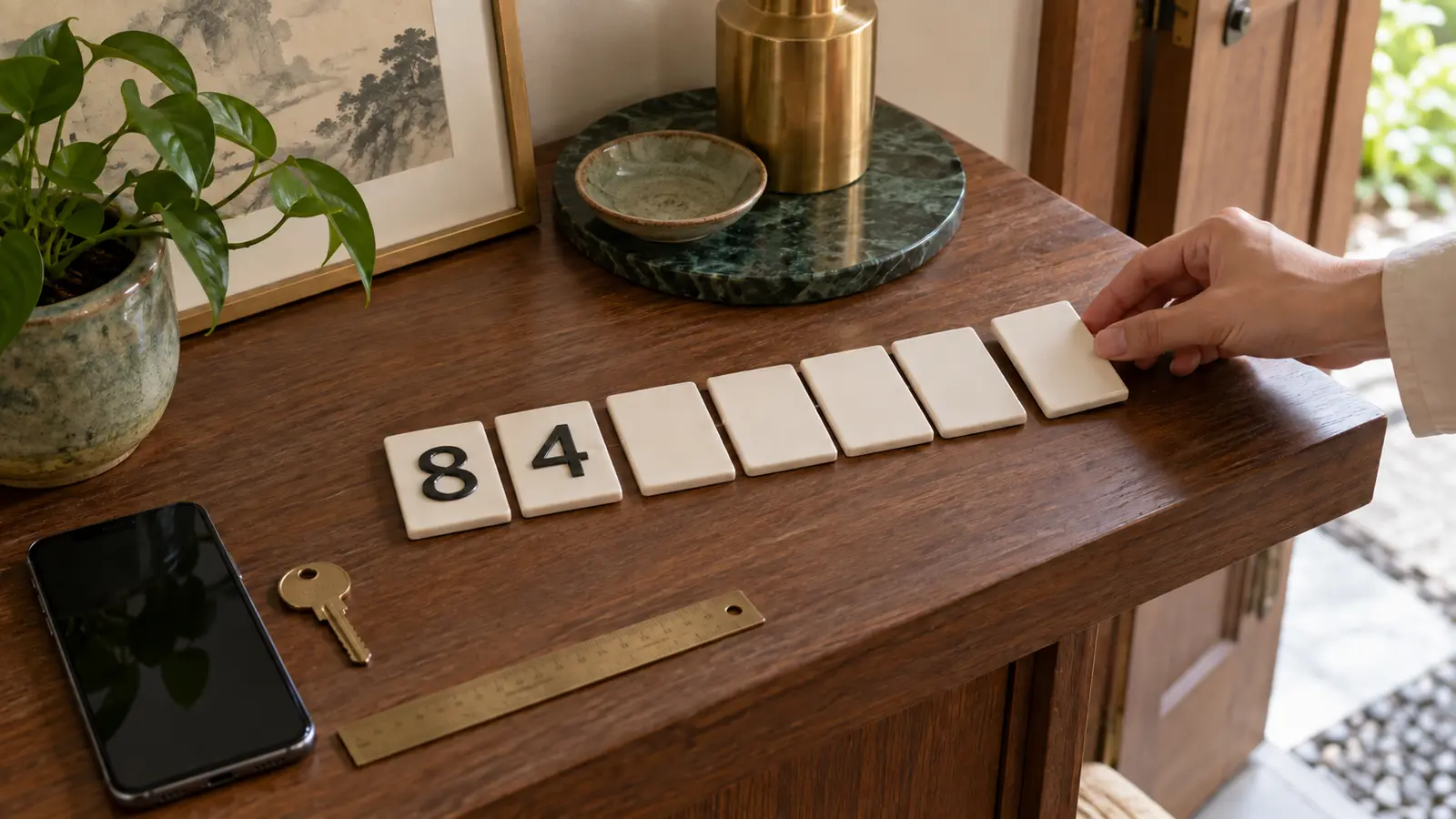
Imagine two complete phone numbers that both contain an 8. The pairs formed before and after that digit may differ, the 8 may appear in a different position, and one number may be used constantly while the other is rarely active. Under Eight Star rules, those are not equivalent inputs. The same logic applies to two addresses containing 4.
This is a method example, not a hidden lucky-number suggestion. A proper comparison needs the complete relevant source; it should not be reverse-engineered from one visible digit.
Can cultural preference still matter in a practical decision?
Yes. A culturally preferred number may be easier to remember, feel more comfortable, attract more interest in a market or carry a higher asking price. A less preferred digit may affect how some buyers, tenants, guests or family members respond. These are practical social effects, not proof of supernatural causation.
For property, vehicle or business decisions, compare that perception with price, location, quality, legal checks, affordability, usability and other real evidence. Paying a large premium—or rejecting an otherwise suitable option—because of one digit deserves careful thought.
A responsible way to assess a number containing 8 or 4
- Name the decision: Are you choosing a phone number, address, vehicle registration or business source? The purpose changes what evidence matters.
- Acknowledge the cultural feeling: You do not have to dismiss comfort or family preference, but describe it as preference rather than certainty.
- Keep the complete source: Do not remove every digit except 8 or 4. Preserve the full usable number and its order.
- Use one rulebook consistently: If using Eight Star, assess its recognised pairs and context without adding a separate single-digit lucky list.
- Check practical evidence: Review cost, contracts, safety, condition, records and qualified advice before an important commitment.
- Leave room to disagree: Another person can understand the cultural story and still make a different, reasonable choice.
What should you avoid concluding?
Do not conclude that more 8s automatically make a number better, that one 4 makes a number dangerous, or that a culturally preferred date guarantees a favourable event. A number interpretation should never be used to diagnose a condition, identify a threat, assign blame or replace medical, legal, financial, safety or mental-health advice.
Frequently asked questions
Is 8 always lucky?
No. It is widely treated as auspicious in some cultures, but a cultural association cannot guarantee wealth, success or any other outcome.
Is 4 always unlucky?
No. Some people avoid it because of a sound association in certain Chinese languages, but the digit does not predict harm, illness, loss or death.
Does having more 8s make a phone number better?
Not automatically. Eight Star reads recognised adjacent pairs across the complete source, along with order, purpose and use. Repeating one digit is not a complete assessment.
Should I avoid a house or unit number containing 4?
That is a personal and practical choice. Consider your comfort and possible market perception alongside price, location, condition, legal checks and suitability. The digit alone does not establish danger.
Can cultural preferences be considered in an Eight Star assessment?
They can be noted as part of the person's context, but they should not replace the method's complete-source rules or be presented as proof of an outcome.
Is Eight Star Number Energy scientifically proven?
No. It is a traditional interpretive framework, not an established physical science or a substitute for evidence and qualified advice.
Eight and four can carry cultural meaning without controlling your future.
Respect the cultural association, keep personal preference separate from proof, and—if you use Eight Star—return to the complete sequence and its real purpose.