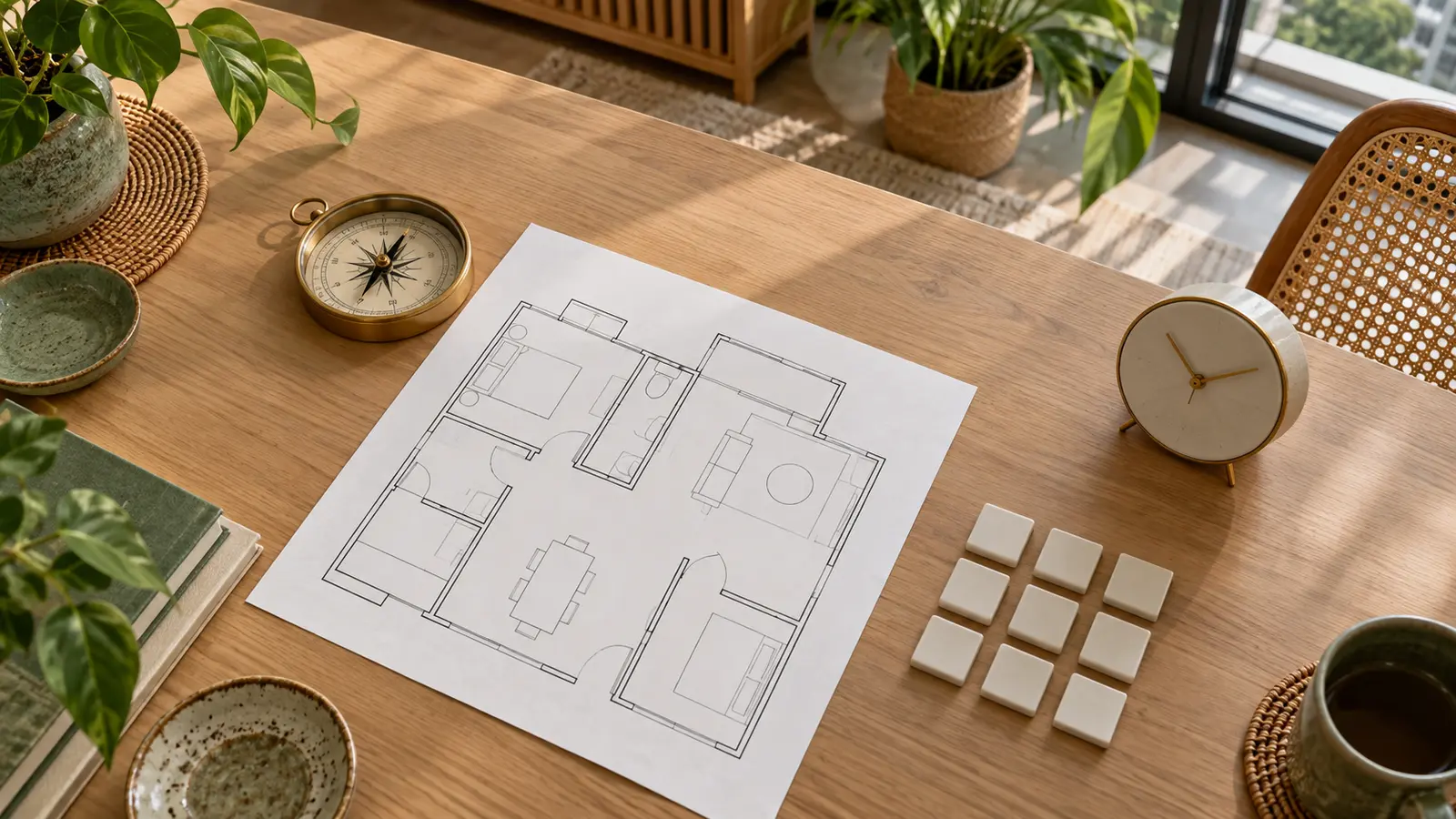
Numbers appear throughout conversations about Feng Shui, but they do not always do the same job. An eight may describe how many trigrams belong to the Bagua, a set of numbers may occupy positions in the Lo Shu, and numbered stars may identify patterns that a Flying Star school relates to place and time. None of those uses means that every visible digit carries one fixed effect for every home.
The short answer: numbers organise parts of some Feng Shui systems.
Feng Shui is primarily a traditional Chinese framework for considering relationships among people, surroundings, form, layout, orientation and, in some schools, time. Numbers may help a school name categories, arrange positions, record directions or distinguish time-related configurations. Their meaning comes from the framework using them—not from the digit alone.
If you are new to the environmental foundation, begin with What Is Feng Shui? A Simple Guide for Modern Homes. This page goes one level deeper into the numbered models.
Four different jobs a number can perform
Before interpreting a Feng Shui number, identify its function. The same symbol can be doing very different work:
| Job | What the number is doing | What not to assume |
|---|---|---|
| Counting | States how many parts a model contains—for example, the eight trigrams of the Bagua. | That the count gives the digit a personal lucky meaning. |
| Labelling | Names a category, position or traditional pattern so practitioners can refer to it consistently. | That the label works like a house-number or phone-number interpretation. |
| Arranging | Shows how numbered positions relate within a spatial model such as the Lo Shu square. | That removing one number from the arrangement preserves the model’s meaning. |
| Indexing direction or time | Helps distinguish compass measurements, sectors, periods or changing configurations in a chosen school. | That a numbered pattern stays identical in every direction, building or time period. |
Bagua: eight describes a set of trigrams
Bagua means “eight trigrams”. The important subject is the eight symbolic trigrams and their relationships, not an isolated lucky meaning for the digit 8. Different Feng Shui applications may relate trigrams to directions, qualities or parts of a space, depending on the school. A full Bagua explanation belongs to its own guide; here, the key point is that the number is first a count within a structured model.
The shared word “eight” does not make the Bagua equivalent to Monad Mind’s Eight Star Number Energy. Similar vocabulary is not evidence of a shared calculation method.
Lo Shu: numbers matter because of their positions and relationships
The Lo Shu is a traditional square arrangement of numbers. Its relevance comes from the complete pattern—where the numbers sit and how positions relate—not from treating each digit as an independent recommendation. Later Feng Shui traditions use the arrangement in their own ways, but a beginner does not need a calculation table to understand the principle: moving from a structured layout to a loose lucky-number list loses important context.
This article does not reproduce formulas, chart preparation or prescriptive digit lists. The dedicated Lo Shu guide will explain its history and role at an educational level.
Flying Stars: numbered labels can connect space with time
Flying Star schools use numbered stars within charts that consider spatial sectors and time cycles. In that setting, a number identifies a traditional star or configuration; it is not simply the visible digit on a door. The same label may be discussed differently according to its position, relationships and the period being considered. This is why a fixed list of “good Feng Shui numbers” cannot explain a time-based method.
Compass numbers measure direction before anyone interprets symbolism
Feng Shui schools that use a compass first need a reliable orientation. Degrees are measurements. They help record where a property or feature faces, just as measurements help describe a floor plan. A bearing does not become beneficial or difficult merely because it contains a culturally preferred digit. The chosen school determines how orientation is used after the practical measurement is made.
Cultural digit symbolism is related to the conversation—but separate
In Malaysia and other Chinese-speaking communities, 8 and 4 are often discussed through sound associations, custom, personal comfort and market response. Those associations may influence what buyers, tenants, families or businesses prefer. That is a cultural and social layer. It is not the same as counting Bagua trigrams, reading positions in the Lo Shu or following a Flying Star time cycle.
For the cultural question, use the existing guide Are 8 and 4 Always Lucky or Unlucky? It owns that search intent without turning a cultural preference into a Feng Shui rule.
Is the number on the door one of these Feng Shui numbers?
Not automatically. A house or unit number begins as an identifier. Someone may interpret it through cultural symbolism or a named numerology method, and some practitioners may note it as an optional layer. It still cannot describe the land, approach, building form, entrance, internal layout, orientation, occupants or time factors that make up a broader Feng Shui assessment.
If your question is about the digits in a property identifier, continue to What Can Your House Number Tell You? That guide addresses the complete property-number source rather than repeating it here.
One condominium can contain several kinds of numbers
Imagine a Malaysian condominium with a block name, a floor, a unit number, lift labels, compass bearings and a year of completion. Seeing many numbers does not mean they should be joined into one calculation:
- Orientation measurement: A compass bearing records direction for a Feng Shui method that uses orientation.
- Traditional model labels: Numbered positions or stars belong to the rules of the selected Feng Shui school.
- Address identifiers: The block, floor and unit help people locate the home; analysing their digits is a separate number-source question.
- Cultural preference: A digit may feel attractive or uncomfortable because of language, family custom or resale perception.
- Practical measurements: Floor area, travel time, price and maintenance figures support ordinary housing decisions, not symbolic interpretation.
Keep each number attached to the question that produced it. Do not combine every visible digit merely because they appear around the same property.
Ask these five questions before interpreting a Feng Shui number
Name the school
Which Feng Shui tradition or method is using the number? A label without a rulebook is easy to misread.
Identify the job
Is it counting, labelling, arranging, measuring direction or indexing time?
Keep the complete model
What positions, relationships, sectors or periods give the number its context?
Separate other layers
Is the statement actually about cultural sound, a house identifier or a numerology system instead?
Return to the real decision
Safety, building rules, affordability, condition and comfort come before symbolic interpretation.
How is this different from Monad Mind’s Eight Star framework?
Monad Mind’s Eight Star Number Energy sits on the number-analysis side, not the building-Feng-Shui side. It considers complete active number sources—such as a mobile number, IC, prepared name, vehicle registration, property number or business source—and recognised adjacent relationships in sequence, together with purpose, context and exposure. It does not calculate a Bagua, Lo Shu or Flying Star chart for a building.
The distinction is developed in Is Feng Shui the Same as Numerology? Different frameworks may be considered separately, but their inputs and formulas should never be blended into a new system.
Numbered models do not turn Feng Shui into established physical science
Feng Shui should be described as a traditional interpretive framework. A numbered chart cannot prove that a feature caused an event, certify structural or fire safety, diagnose health, guarantee protection, wealth, recovery, relationships or business results, or predict an exact date. Use qualified building, legal, financial, medical and safety advice for high-stakes questions, and keep traditional interpretation conditional.
Frequently asked questions
Are numbers important in Feng Shui?
They can be important within schools that use numbered categories, spatial arrangements, compass measurements or time cycles. Their role depends on the complete method.
Does every Feng Shui number have a lucky or unlucky meaning?
No. A number may simply count or label part of a model. Even an interpreted label needs its position, relationships, school and time context.
Are the eight Bagua trigrams the same as Eight Star Number Energy?
No. Bagua is a traditional set of eight trigrams used in Chinese thought and Feng Shui applications. Monad Mind’s Eight Star framework analyses complete active number sources and adjacent relationships.
Is the Lo Shu a lucky-number chart?
It is a traditional arrangement whose positions and relationships matter. Reducing it to a shopping list of preferred digits removes the structure that gives it context.
Why can Flying Star numbers change with time?
Flying Star schools relate numbered stars to spatial positions and time cycles. The numbers function as labels within that changing model, not as permanently lucky house digits.
Is my house number part of Feng Shui?
It may be noted as an optional symbolic layer, but it is not the complete Feng Shui of a property. Interpreting its digits usually belongs to cultural symbolism or a number-analysis system.
First ask what the number is doing.
A Feng Shui number may count, label, arrange, measure or track a traditional pattern. Once its role is clear, you can understand the model without confusing it with a cultural preference, a door number or a separate numerology system.