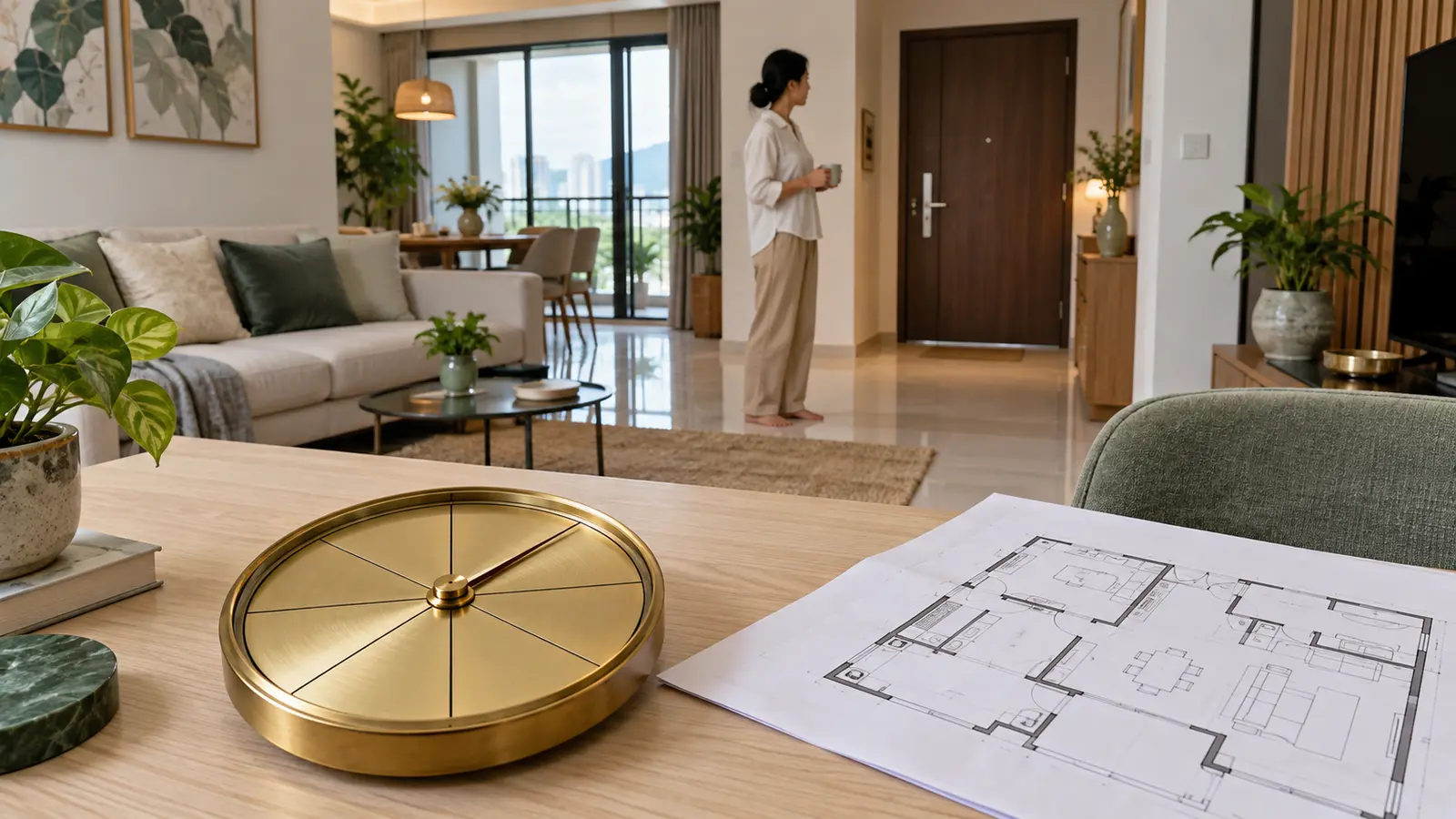
People often meet the Bagua as an eight-part shape on a compass, a floor-plan overlay or a decorative object. That familiar image can make it look like a simple map of eight lucky areas. Its actual background is broader: the Bagua is a set of eight traditional trigrams used in Chinese thought to describe qualities, relationships and patterns of change. Feng Shui traditions may connect those trigrams with directions or parts of a space, but the Bagua is not a house-number calculation and it is not Monad Mind’s Eight Star Number Energy framework.
The short answer: Bagua is a set of eight symbolic trigrams.
Each trigram is formed from three stacked lines. A solid line and a broken line represent contrasting yin and yang qualities; different three-line combinations create eight trigrams. Their meaning comes from the complete symbol, its relationships and the arrangement being used—not from treating the digit 8 as a personal recommendation.
What does the word Bagua mean?
In Chinese, ba means eight and gua refers to a trigram or symbolic figure. The name therefore counts the eight members of a set. It does not say that the number eight is automatically beneficial, nor does it turn every eight-sided object into a complete Feng Shui analysis.
If you first want to understand why Feng Shui uses numbers to count and organise models, read How Are Numbers Used in Feng Shui? This page focuses only on what the Bagua is and what it is not.
How can two line types produce eight trigrams?
A trigram has three line positions. Each position can use either a solid or broken line. The resulting combinations form eight distinct symbols. At a beginner level, three points matter:
The lines are relational
A line is read within a three-line figure. Pulling it out of the trigram removes the structure that gives it context.
The trigrams form a set
The Bagua is not eight unrelated icons. Traditions examine contrasts, correspondences and transitions among them.
The arrangement matters
The same trigram can be discussed within different established arrangements and applications. A diagram should identify which arrangement it represents.
What do the trigrams represent?
Traditional explanations associate the trigrams with images and qualities drawn from nature, family relationships, movement and change. These correspondences are symbolic language within a traditional framework. They are not measurements of invisible physical energy and should not be used as proof that one room caused an event.
A beginner does not need to memorise every correspondence before understanding the principle: the trigram is a compact symbol inside a larger network of relationships.
Why can Bagua diagrams look different?
Two well-known arrangements are commonly described as Earlier Heaven and Later Heaven arrangements. They place the trigrams in different orders because they serve different traditional contexts. A practitioner should not silently swap one for the other, rotate a chart without explaining the reference, or present one internet diagram as the only universal Bagua layout.
- An eight-sided border alone does not identify the arrangement.
- A phone app or printed chart should name its school, orientation and purpose.
- Compass direction, the building’s actual form and the selected method remain separate pieces of information.
- No arrangement becomes a list of eight universally lucky rooms or digits.
How is the Bagua used in Feng Shui?
Some Feng Shui approaches relate the trigrams to compass directions, spatial sectors, qualities or other parts of a wider reading. The Bagua then helps organise information about the environment. It does not replace the site, approach, entrance, room layout, orientation, occupants or, in schools that use it, time.
Start with the real space
Record the home’s form, entrance, rooms, movement, light, heat, noise, ventilation and surroundings.
Name the method
Confirm how the chosen Feng Shui school uses the Bagua and which arrangement or orientation it requires.
Keep the overlay accountable
Explain the reference point instead of rotating or stretching a diagram until it produces a preferred answer.
Return to practical priorities
Safety, building rules, affordability, comfort and professional inspections come before symbolic interpretation.
Is the Bagua simply a floor-plan map?
A floor-plan overlay is one modern way people encounter the Bagua, but the overlay is not the Bagua’s entire history or meaning. Different schools can define orientation and application differently. A cropped online graphic without its method, direction or reference point cannot support a careful property conclusion.
What about a Bagua mirror or eight-sided ornament?
A Bagua mirror is a specific cultural object, not a substitute for understanding the home. It should not be presented as a guaranteed cure, protection device or solution for structural, safety, relationship, health or financial problems. Placement can also affect neighbours, shared corridors and building rules, so permission, courtesy and ordinary safety matter.
Why Bagua is not Eight Star Number Energy
| Bagua | Monad Mind’s Eight Star Number Energy |
|---|---|
| Begins with eight traditional trigrams and their relationships. | Begins with a complete active number source selected for a real question. |
| May be used to organise directions, qualities or spatial sectors within a Feng Shui method. | Reads recognised adjacent relationships in the number sequence, together with source, purpose, context and exposure. |
| The word eight counts the trigrams in the set. | The word Eight Star names eight recognised pattern categories in its own number-analysis framework. |
| Does not interpret a mobile, IC, name, plate or property number as a Bagua chart. | Does not calculate a building’s Bagua, Lo Shu or Flying Star chart. |
Both traditions can use the word eight and may be considered as separate perspectives. That shared vocabulary is not permission to merge their inputs, charts or formulas into a new system.
Four ideas that are often confused
- Bagua: Eight symbolic trigrams and their relationships within Chinese thought and some Feng Shui applications.
- The digit 8: A numeral that may also carry cultural sound associations or market preferences in Chinese-speaking communities.
- A house number: An address identifier that can be considered separately through cultural symbolism or a named number-analysis method.
- Eight Star Number Energy: A framework for complete active number sources and adjacent patterns; it is not a Bagua map.
For the broader system comparison, continue to Is Feng Shui the Same as Numerology? For cultural beliefs about 8, use the existing 8-and-4 guide rather than importing those beliefs into the Bagua.
Common beginner mistakes
Calling every octagon a Bagua reading
Shape alone does not show the trigrams, arrangement, orientation or method.
Treating eight sectors as eight predictions
A sector label cannot guarantee wealth, health, relationships or any exact event.
Using a preferred digit to explain the trigrams
The Bagua’s eight counts a structured set; it is not a lucky-number recommendation.
Combining unrelated charts
Bagua, Lo Shu, Flying Stars, cultural symbolism and Eight Star each require their own inputs and rules.
What the Bagua cannot prove
The Bagua is part of a traditional interpretive framework, not established physical science. A Bagua reading cannot certify a building, diagnose health, prove causation, prevent accidents, guarantee protection, wealth, recovery or relationships, or predict an exact date. Use qualified building, fire-safety, medical, legal and financial advice for high-stakes decisions.
Frequently asked questions
What does Bagua mean?
Bagua means eight trigrams: a traditional set of eight three-line symbols used to express relationships and change.
Is the Bagua a lucky-number chart?
No. Eight counts the trigrams in a structured set. It does not make the digit 8 a universal recommendation.
Is Bagua the same as Eight Star Number Energy?
No. Bagua concerns eight trigrams used in Chinese thought and some Feng Shui methods. Eight Star analyses complete active number sources and recognised adjacent patterns.
Can I place the Bagua over any floor plan?
Different schools use different arrangements, orientation rules and reference points. A diagram without its method is not enough for a careful conclusion.
Does each Bagua sector predict one part of life?
Sector associations are traditional symbolic categories, not guaranteed predictions. The complete space, selected method and practical evidence still matter.
Will a Bagua mirror fix bad Feng Shui?
No object can guarantee a cure or protection. Consider building rules, neighbours and safety, and address practical problems directly.
The important “eight” is the complete set—not a lucky digit.
Once you see the Bagua as eight related trigrams, the confusion becomes easier to avoid. Feng Shui may use the set to organise a spatial interpretation. Eight Star Number Energy examines complete active number sources. Keeping those starting points separate makes both explanations clearer and more responsible.