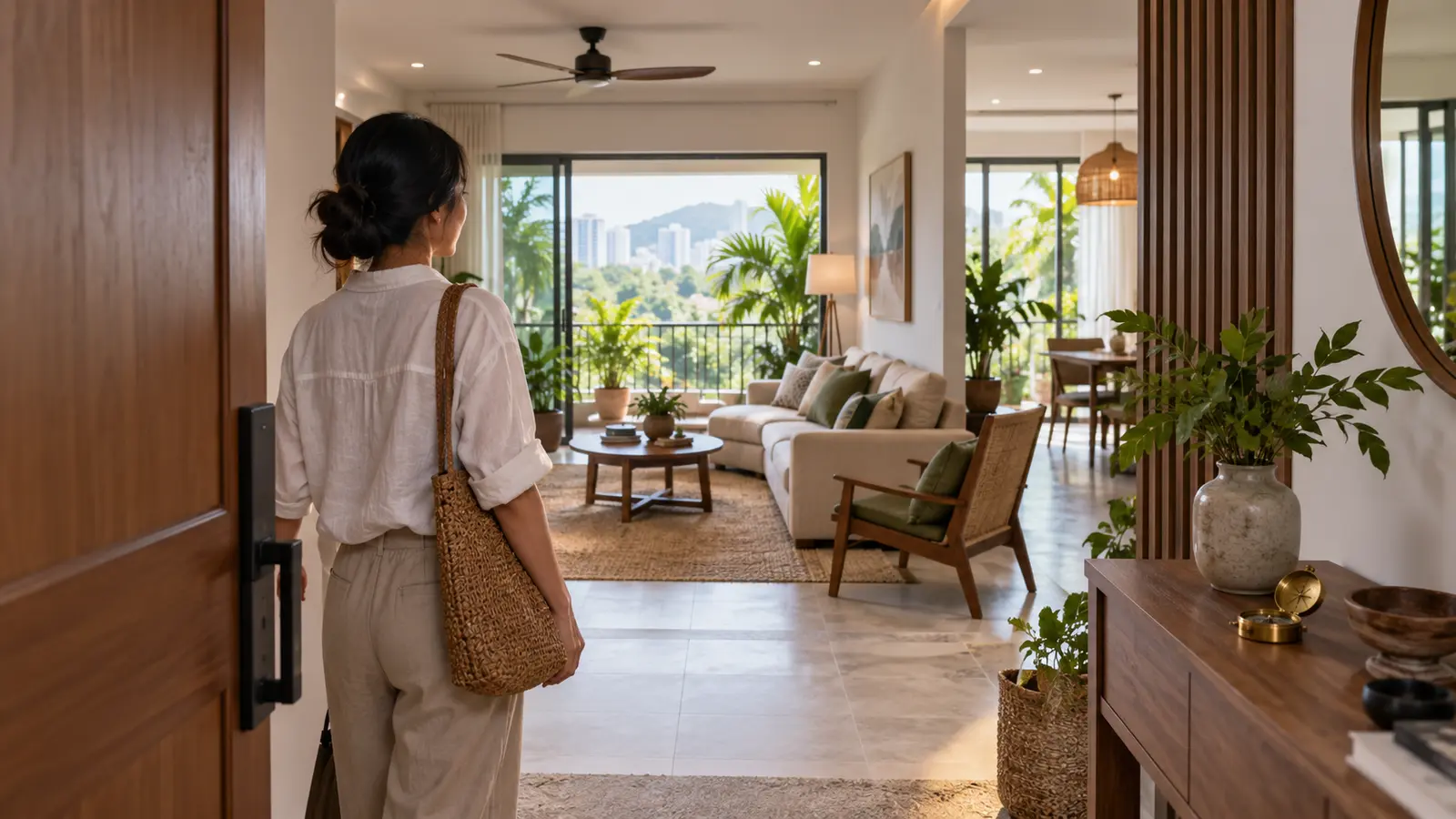
When people hear “Feng Shui,” they may think of lucky colours, a wealth corner, mirror rules or an auspicious house number. Those familiar ideas are only fragments of a much wider tradition. Feng Shui looks primarily at the relationship between people and places: the land and buildings around a home, the entrance, the arrangement and use of rooms, orientation, movement and—in some schools—time.
The short answer: Feng Shui is about people in environments.
Feng Shui is a traditional Chinese interpretive framework used to examine how a place is formed, oriented and experienced. Its name, 风水, literally means “wind and water.” Different schools use different rules, but a complete view is broader than decoration and cannot be reduced to one object, colour, direction or digit.
It should not be presented as established physical science or as a way to guarantee wealth, health, safety, love or a particular event. A responsible reading is one perspective alongside practical observation, evidence and professional advice.
What may a Feng Shui assessment examine?
The exact method depends on the school and purpose of the assessment. Four broad dimensions help a beginner understand the scope:
| Dimension | What it may include | A modern-home question |
|---|---|---|
| Surroundings and form | Roads, neighbouring buildings, slopes, open space, water and the shape of the site or building. | Does the home feel sheltered, exposed, blocked or constantly disturbed by what is outside? |
| Entrance and layout | The main door, rooms, corridors, doors, furniture and the way people move through the space. | Can people enter, rest and work without awkward obstruction or constant interruption? |
| Orientation | The facing and sitting direction of a property and the orientation of important areas, according to the chosen school. | Which direction does the property actually face, and how was that determined? |
| Time and use | In some schools, time periods are considered together with when a property was built, occupied or altered. | Who uses each space now, for what purpose, and has that purpose changed? |
Feng Shui in a modern Malaysian home
A modern home does not need to resemble an ancient courtyard for Feng Shui questions to arise. The same broad ideas can be considered in a condominium, terrace house, rental room or home office. For example:
A condominium entrance
A door opening into a tight passage may change how arrival and movement feel. Before adding a symbolic object, first check lighting, storage, door clearance and fire-safety access.
A combined bedroom and workspace
One room may need both quiet rest and active work. Zoning, light, screen placement and the daily routine may matter more than copying a fixed furniture rule.
A desk beside household traffic
Frequent movement behind or beside a desk may feel distracting or exposed. A change of position, visual boundary or work schedule can be considered practically first.
Heat, glare, noise or poor airflow
These conditions can affect comfort and concentration. Ventilation, shading, maintenance and building advice take priority over symbolic explanations.
A terrace house near a busy junction
The external approach, headlight glare, noise and pedestrian safety are real conditions. Feng Shui may offer an interpretive lens, but ordinary safety measures remain essential.
Qi, yin-yang and the Five Elements—without the mystery
These terms appear often in Feng Shui, but an introductory article should keep their roles clear:
- Qi: A traditional concept used to discuss the quality and movement of influence through a place. In Feng Shui writing it is not the same as a scientifically measured physical force.
- Yin and yang: A way of considering complementary qualities—such as quieter and more active, shaded and bright, enclosed and open—rather than treating one side as always good.
- Five Elements: Wood, fire, earth, metal and water form a symbolic relationship framework. They can describe qualities and interactions; they are not a list of guaranteed cures.
Later guides in this collection will explain these ideas in more depth. For now, the important point is that Feng Shui considers relationships and balance within a whole setting, not isolated decorative labels.
Is Feng Shui just furniture placement?
No. Furniture is visible and easy to change, so it receives a lot of attention online. Traditional Feng Shui may begin much earlier—with landform, the building, external approach, entrance and orientation. A sofa or bed position can affect movement, privacy, light and comfort, but shifting one item does not automatically change the complete character of a property.
Renters also do not need to rebuild a home to observe it carefully. Small, reversible changes may improve function or comfort. Follow tenancy terms, strata rules, fire-safety requirements and qualified building advice before changing doors, walls, wiring, plumbing or ventilation.
Why do numbers appear in Feng Shui?
Some Feng Shui traditions use numbers as labels for positions, trigrams, symbolic relationships or time-related configurations. A number in that context may identify a category or changing pattern; it does not automatically mean that the digit carries one universal lucky or unlucky effect.
- The Bagua uses eight trigrams, but “eight” does not make Bagua the same system as Eight Star Number Energy.
- The Lo Shu square arranges numbers within a traditional pattern; it is not a general instruction to choose those digits for every home.
- Flying Star schools use numbered stars and time cycles; those numbers do not function like a fixed list of lucky house numbers.
- Cultural sound associations—such as familiar beliefs around 8 or 4—can influence preference and market behaviour, but they are not the complete Feng Shui of a property.
For that last distinction, read Are 8 and 4 Always Lucky or Unlucky? It separates cultural meaning from a complete number analysis.
Feng Shui, numerology and Eight Star are not interchangeable
They can all appear in conversations about homes and numbers, but they begin with different information and answer different questions:
| Framework | Primary focus | Typical information considered |
|---|---|---|
| Feng Shui | Relationships between people and environments. | Surroundings, form, entrance, layout, orientation and, in some schools, time. |
| Cultural number symbolism | Meanings a community associates with particular digits. | Language, sound, custom, personal preference and social or market response. |
| Numerology | Symbolic interpretation of numbers through a defined system. | Dates, names, addresses, totals or sequences, depending on the method. |
| Monad Mind’s Eight Star Number Energy | Patterns within complete active number sources. | The complete prepared source, adjacent relationships, order, purpose, context and exposure. |
The broader guide What Is Numerology—and How Is Eight Star Numerology Different? explains why systems that use numbers cannot simply be merged into one formula.
Is a house number part of Feng Shui?
A house or unit number may be one optional interpretive layer, but it is not the complete Feng Shui of the property. The number on the door cannot describe the surrounding roads, building form, entrance, room layout, direction, ventilation, actual users or changes over time.
If the question is specifically about a complete property number, use the dedicated guide What Can Your House Number Tell You? That page owns the number-analysis question; this Feng Shui guide owns the environmental introduction.
What should come first when choosing or improving a home?
Start with matters that affect daily life and cannot be responsibly ignored: affordability, legal title or tenancy terms, structural condition, fire safety, security, accessibility, ventilation, heat, water, noise, commute and the needs of everyone using the home. Then consider layout and orientation, and only after that decide whether cultural symbolism, a house-number reading or another traditional framework adds useful perspective.
A desirable digit does not compensate for an unsafe staircase, serious water damage, unaffordable repayments or a home that does not fit its users.
A simple observation exercise for your home
You can begin without buying an object or calculating a chart:
- Name the real purpose of each room and who uses it most.
- Walk from the main entrance through the home and notice obstruction, sharp turns and spaces people avoid.
- Observe daylight, heat, airflow, noise, privacy and storage at different times of day.
- Separate a practical problem from a symbolic interpretation, and solve urgent practical issues first.
- Record what actually improves after a reasonable change instead of assuming every event is proof.
What Feng Shui can—and cannot—responsibly do
Feng Shui can provide a traditional structure for noticing relationships in a space and asking how a home supports its users. It cannot prove that one feature caused a past event, diagnose illness, certify a building as safe, guarantee protection or predict wealth, recovery, marriage, pregnancy, career success or an exact date. It does not replace medical, legal, financial, engineering, building, fire-safety or mental-health advice.
Frequently asked questions
Is Feng Shui a religion?
Feng Shui is generally described as a traditional Chinese practice or interpretive framework concerned with people and environments. It has interacted with Chinese philosophy, cosmology and local customs, but using Feng Shui is not the same as joining one religion.
Is Feng Shui scientifically proven?
Feng Shui should not be presented as established physical science. Some practical observations about light, heat, movement, privacy or noise can be evaluated directly, while traditional symbolic interpretations belong to a different kind of framework.
Can Feng Shui apply to a condominium or rental home?
Yes, it can be considered as an interpretive perspective. Focus on the actual entrance, internal layout, orientation, surroundings and use of the space. Renters should prioritise safe, reversible changes and follow tenancy and building rules.
Is a house number part of Feng Shui?
It may be considered as an optional symbolic or number-analysis layer, but it is not the complete Feng Shui of a property. The environment, building and use of the home remain separate information.
Is Feng Shui the same as numerology?
No. Feng Shui primarily examines environments. Numerology interprets numbers through a defined system. Some Feng Shui schools use numbered categories, but that does not make the methods interchangeable.
Do I need to change my home to improve its Feng Shui?
Not automatically. Begin with observation and practical priorities. Some concerns may be addressed through ordinary organisation, lighting, ventilation, privacy or maintenance; structural changes require permission and qualified advice.
Begin with the home you actually live in—not a list of lucky objects.
Observe the surroundings, entrance, movement, comfort and purpose of each space. When numbers enter the discussion, first ask whether they are being used by Feng Shui, cultural symbolism or a numerology system. Keeping those frameworks separate makes every later question clearer.