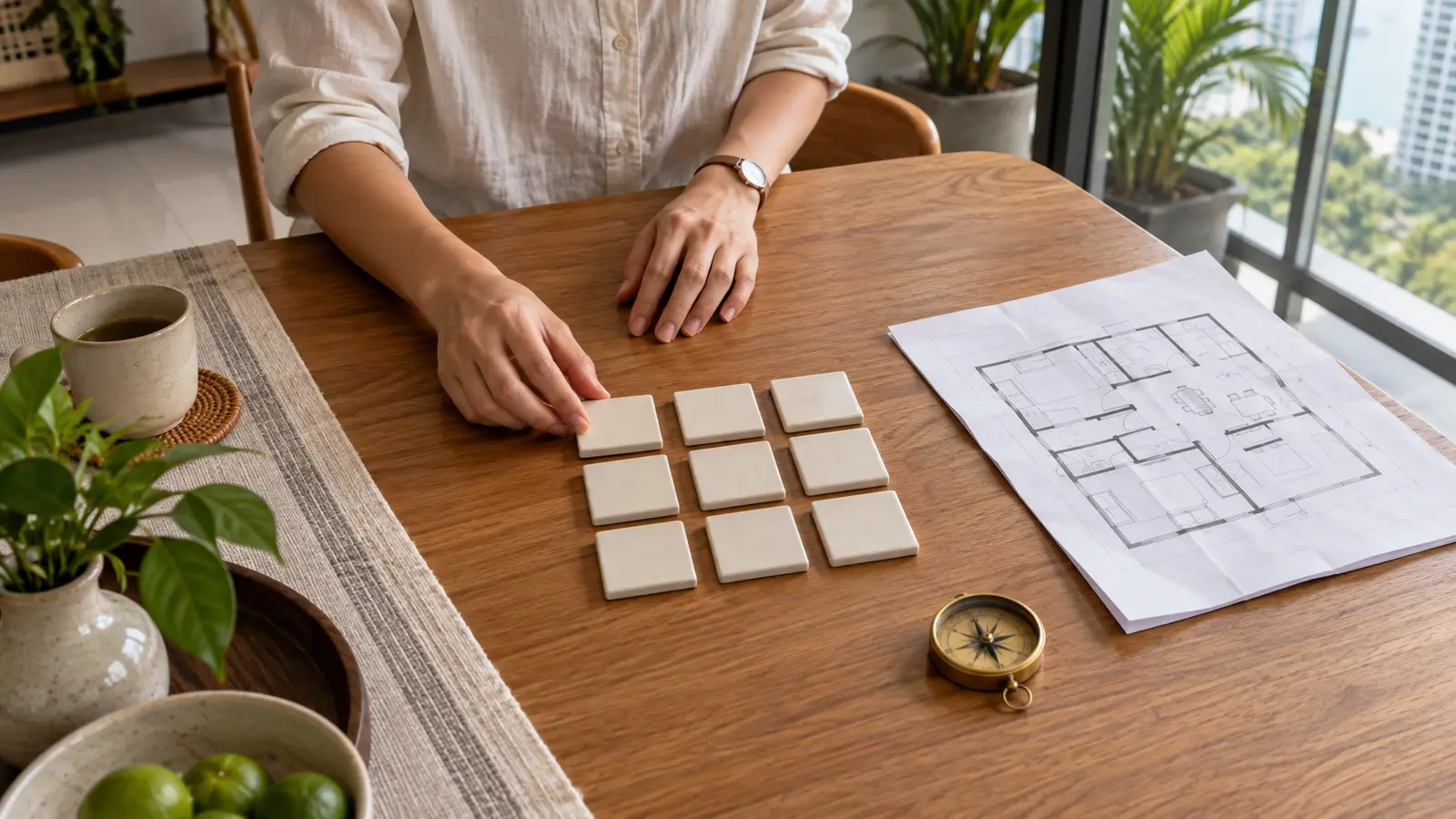
People often first see the Lo Shu as a small square filled with numbers. Because it looks simple, it is easy to assume that each cell offers a lucky digit for a room, address or phone. That misses the point. The Lo Shu is a traditional three-by-three arrangement in which the numbers one to nine occupy related positions. It became important within broader Chinese cosmological thought, and later traditions—including some Feng Shui schools—used its ordered structure as one way to organise directions, qualities or changing patterns.
The short answer: the Lo Shu is an arrangement, not a shopping list.
The Lo Shu places nine numbers in a structured square. A defining mathematical feature is that each straight row, column and diagonal reaches the same total. In traditional interpretation, however, the important idea is wider than arithmetic: every number belongs to a position, a relationship and a complete model. Removing a digit and calling it universally lucky strips away the structure that made the square meaningful.
Where does the Lo Shu story come from?
Traditional accounts connect the Lo Shu with markings observed on a turtle emerging from the Luo River. The image was understood as an ordered pattern and became part of a much larger body of Chinese symbolic thought. This should be presented as a traditional cultural narrative, not as a scientifically verified event or proof that a diagram carries physical power.
Historical retellings and later uses developed across long periods. A modern article should distinguish the traditional story, the mathematical square and the ways later schools interpret it instead of treating them as one unchanged practice.
What makes the Lo Shu a square?
At a beginner level, four features explain why the complete arrangement matters:
Nine positions
A three-by-three square creates eight surrounding positions and a centre. The centre is part of the structure, not an empty decoration.
Numbers one to nine
Each number appears once in the classic arrangement. Their placement—not personal preference—creates the recognised pattern.
Balanced line totals
Rows, columns and diagonals share the same total. This is a mathematical property of the arrangement, not a promise of balance in someone’s life.
Relationships across the whole
Opposing, neighbouring and central positions can be discussed within later symbolic systems. One isolated cell cannot explain the complete model.
Why do numbers appear here?
In the Lo Shu, numbers do more than label boxes. They preserve an ordered relationship across the square. That makes the model useful for traditions that organise correspondences—such as direction, sequence, phase or time—through a consistent set of positions. The number is meaningful inside that framework because of where it sits and how it relates to the rest.
- Position: A number identifies one place within the complete square.
- Relationship: Its meaning may involve the centre, nearby positions or an opposing position in the selected tradition.
- Correspondence: Later systems may associate positions with directions, trigrams, Five-Phase qualities or other established categories.
- Reference: A stable arrangement lets practitioners discuss a model consistently; it does not make every visible digit a personal message.
How did the Lo Shu become connected with Feng Shui?
Feng Shui is primarily concerned with relationships among people, surroundings, form, layout, orientation and, in some schools, time. Later cosmological and Feng Shui traditions connected the Lo Shu’s numbered positions with other systems of correspondence. Depending on the school, it may help organise spatial sectors, directions, trigrams, Five-Phase relationships or time-related charts.
That does not mean every Feng Shui school uses the Lo Shu in exactly the same way. Begin with How Are Numbers Used in Feng Shui? to see why a number can count, arrange, label or track different things in different methods.
Is the Lo Shu the same as the Bagua?
No. The Bagua is a set of eight trigrams. The Lo Shu is a numbered three-by-three arrangement. Later traditions may relate trigrams, directions and Lo Shu positions, which is why the two often appear in the same diagram or conversation. Connection does not erase their different starting points.
The dedicated Bagua guide explains why eight trigrams are not eight lucky digits and are not Monad Mind’s Eight Star framework.
Is the Lo Shu a Flying Star chart?
It is a foundation used within some later time-based systems, but a basic Lo Shu square is not by itself a complete Flying Star chart. Flying Star schools place numbered stars into positions according to their own time, orientation and chart-preparation rules. A static Lo Shu image therefore cannot tell a reader what applies to every building or period.
The next dedicated guide explains why Flying Star numbers can move or be discussed differently across time. This page does not publish chart-preparation steps, formulas or prescriptive sector remedies.
Is the Lo Shu a chart of lucky and unlucky numbers?
Not in the simple way online lists often suggest. Later traditions can attach qualities to numbered positions, but those qualities remain part of a complete method. They should not be copied into a universal rule that a matching house, floor, unit, phone or car-plate digit is always beneficial or difficult.
- A position in a structured chart is not the same thing as a digit printed on a door.
- A traditional correspondence is not proof of a physical cause or guaranteed event.
- Cultural sound associations around digits such as 8 and 4 belong to a separate social and linguistic layer.
- A person’s preferred number does not alter building condition, fire safety, ventilation, price or legal status.
For the cultural question, use Are 8 and 4 Always Lucky or Unlucky? rather than treating the Lo Shu as a digit-ranking table.
How is the Lo Shu different from Monad Mind’s Eight Star Number Energy?
| Lo Shu | Monad Mind’s Eight Star Number Energy |
|---|---|
| Begins with a fixed three-by-three arrangement of nine numbered positions. | Begins with one complete active number source selected for a real question. |
| Meaning depends on position and relationships within the square and the later tradition using it. | Reads recognised adjacent relationships in sequence, together with source, purpose, context and exposure. |
| May help organise spatial or time-related correspondences in some Feng Shui systems. | Examines mobile, IC, prepared name, vehicle, property or business number sources; it does not calculate a building chart. |
| Does not turn one square position into a universal lucky house or phone digit. | Does not import Lo Shu positions, Bagua sectors or Flying Star charts into its number sequence. |
The two frameworks may both discuss numbers and relationships. That is a broad similarity, not a shared formula. Their inputs, units and questions must remain separate.
What does the Lo Shu tell you about a modern home?
By itself, a Lo Shu image does not assess a condominium or landed house. A careful Feng Shui review would still need the real surroundings, building form, entrance, layout, orientation, use of rooms and any time factors required by the named school. A screenshot of a numbered grid cannot replace those inputs.
Start with the actual property
Check affordability, legal status, building condition, safety, access, comfort, heat, noise, light and ventilation.
Name the Feng Shui method
Ask how that school uses Lo Shu positions and what additional information it requires.
Keep the chart accountable
Confirm orientation, time reference and placement rules instead of rotating a diagram until it gives a preferred answer.
Keep number analysis separate
If the concern is the house or unit identifier itself, analyse that source through a clearly named number system.
Common beginner mistakes
- Copying one cell as a lucky digit: The Lo Shu’s meaning comes from the whole arrangement, not a number removed from its position.
- Treating every nine-box grid as the same chart: A diagram should identify its system, orientation, time reference and purpose.
- Combining Bagua, Lo Shu and Flying Stars without rules: These ideas can be related in established traditions, but they are not interchangeable labels.
- Using the grid to make high-stakes claims: A symbolic model cannot certify safety, diagnose health, prove causation or guarantee an outcome.
What the Lo Shu cannot prove
The Lo Shu belongs to traditional cultural, mathematical and interpretive contexts; its use in Feng Shui is not established physical science. A chart cannot prove that a position caused an event, certify structural or fire safety, diagnose illness, guarantee protection, wealth, recovery, relationships or business results, or predict an exact date. Qualified building, medical, legal and financial advice takes priority for important decisions.
Frequently asked questions
What is the Lo Shu square?
It is a traditional three-by-three arrangement of the numbers one to nine whose rows, columns and diagonals share the same total.
Is the Lo Shu a lucky-number chart?
No. Its structure depends on the complete arrangement and positions. One digit removed from the square is not a universal recommendation.
Is the Lo Shu the same as the Bagua?
No. The Bagua is a set of eight trigrams; the Lo Shu is a square of nine numbered positions. Later traditions may connect them.
Does every Feng Shui school use the Lo Shu?
No. Feng Shui includes different schools and lineages. The role of the Lo Shu depends on the named method.
Can the Lo Shu tell me whether my house number is lucky?
Not by itself. A chart position and an address digit are different kinds of information. House-number interpretation belongs to a separate cultural or number-analysis question.
Is the Lo Shu scientifically proven?
Its equal line totals are a mathematical fact. Symbolic Feng Shui interpretations are traditional frameworks, not established physical science or proof of causation.
Read the position, relationship and complete model together.
The Lo Shu helps explain why numbers appear in Feng Shui without turning Feng Shui into numerology. Its numbers belong to a structured square that later traditions use in their own ways. A house number or active number sequence asks a different question and should remain a separate analysis.